
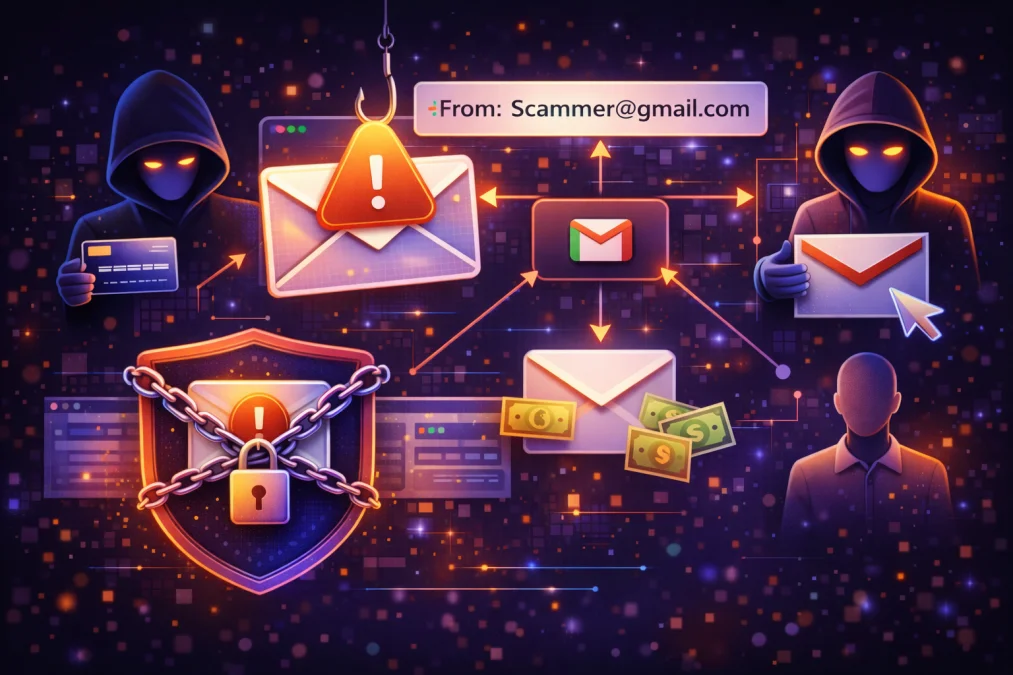
Something deeply frustrating is happening with Gmail's security enforcement. Users are reporting the same scam accounts over and over, following Google's official procedures, yet those fraudulent addresses keep operating for weeks or months.
Multiple businesses have come forward with documented cases showing they've flagged identical Gmail accounts through every available channel, only to see those accounts remain active.
This isn't about a delay of a few days while Google investigates. We're talking about persistent fraud operations that continue despite clear, repeated evidence of abuse.
When Reporting Tools Don't Actually Work
Many companies have reported the same two or three Gmail addresses multiple times through Gmail's built-in reporting feature and Google's dedicated phishing abuse form. Those accounts kept sending fraudulent messages. These companies eventually had to bypass Google's enforcement and warn their client base directly about the ongoing scam.
This pattern reveals a fundamental breakdown in Google's enforcement process. If one account is often marked by several people over long periods, this should prompt quick action and investigation. Victims instead watch helplessly as con artists take advantage of the enforcement gap.
It is crucial to realize that free email services do not actually facilitate communication.
They only send messages from their verified company domain. Any email claiming to be from their team but using a Gmail address is automatically fraudulent. This principle matters for any digital marketing company protecting client relationships from impersonation attacks.
The Technical Sophistication Problem
Gmail faces increasingly cunning attacks that bypass traditional security filters. Replay attacks, in which thieves reuse genuine Google-signed communications, help them circumvent authentication measures. These phishing emails don't have the usual red flags and appear to come from real Google addresses.
No-reply@accounts.google.com fake messages bypass signature validation and appear to be Google security alerts. Victims are directed to bogus login pages hosted on sites.google.com that closely mimic the Google login portal.
Manual reporting becomes especially important when criminals can so readily abuse Google's own authentication mechanisms. Yet those reports apparently don't produce consistent results. The email security ramifications are concerning, as even security-conscious users struggle to distinguish these complex fakes from genuine communications.
Organizations that use expert SEO services and marketing firms routinely face targeted attacks. The scammers know that business relationships involve frequent communication about technical implementations, access credentials, and system changes. This makes impersonation attempts particularly dangerous.
Why Bad Accounts Persist Despite Reports
Several factors explain why fraudulent Gmail accounts survive repeated reporting. The scale of Google's user base creates an overwhelming volume of abuse reports. Millions of complaints are reported daily from billions of active accounts, many involving user conflicts rather than obvious fraud.
Google's systems prioritize automation to handle this volume. As a result, complex cases requiring human judgment may not receive sufficient attention. An automated review might not recognize that the same account has been reported by five different people over three months.
Scammers also game the system by creating backup accounts and rotating between them when one gets flagged. They invest minimal effort per account because Gmail signup requires no payment and limited verification. Even if Google eventually removes an account, the scammer accomplished their objective during the window before enforcement.
The economics favor attackers. Creating fifty Gmail accounts takes an afternoon. Getting even one successful fraud justifies that time investment. Platform enforcement that eventually catches up doesn't deter operations built on volume and disposability.
The Burden Shifts to Businesses
Without reliable platform enforcement, companies must build their own defensive systems. This creates significant resource requirements that disproportionately harm smaller businesses. Big companies use specialist security teams to monitor attempts to impersonate others, train staff and customers, and address issues. Individual professionals and small companies suffer the same risks but without access to those resources.
Any reputable digital marketing company now needs explicit client communication protocols. Document the domains your organization uses for email. Give clients direct phone numbers or proven means of contact they can use to confirm dubious requests. Regularly mention these policies and highlight them on your website.
Employee training programs must address specific impersonation tactics. Users must remain alert when urged to perform urgent tasks, recognize a shady email address, and recognize that social engineering exploits trust and not just technical flaws. Regular security updates help maintain awareness as con artist techniques change.
Google's Misdirected Enforcement Priorities
Interestingly, Google has ramped up enforcement recently, but the focus seems misaligned with actual threats. The platform started closely adhering to technical rules for large senders beginning in November 2025. Messages lacking DMARC, DKIM, and suitable SPF authentication are presently rejected.
One-click unsubscribe options, TLS encryption, and low spam complaint rates are vital steps. They can boost email deliverability and reduce spam. However, they might prove ineffective against targeted impersonation attempts.
A scammer sending personalized messages to a dozen carefully selected victims won't trigger bulk sender thresholds. Those enhanced authentication requirements simply don't apply to the threat model that's causing the most damage.
The assumption that scammers can't configure proper authentication also seems outdated. Sophisticated operations increasingly use legitimate-looking technical setups to pass automated checks, then rely on social engineering to trick recipients. Technical authentication and enforcement of fraudulent account removal require different approaches, yet Google seems heavily invested in the former while neglecting the latter.
Organizations developing digital marketing strategies need to understand these authentication requirements for their own sending infrastructure, but those measures offer limited protection against targeted attacks. Google's enforcement priorities continue to diverge further from real user requirements.
Measures Needed for Real Protection
Given the lack of enforcement, both individuals and companies must act quickly to protect themselves. Never trust an email address alone to confirm identity. When you receive unexpected requests involving sensitive information or system access, verify through alternative communication channels before responding.
Create foolproof verification procedures. Protect your Google Analytics account. Avoid clicking any links included in that email. Don’t confirm the request using a phone number found online. Use one you already have on file. This simple measure effectively prevents most impersonation attempts, regardless of how convincing the email appears.
If the same account keeps running after your first report, report it once more and clearly state that this is a second violation. Record the timeline, noting when you first reported the account and when it started sending false messages. This documentation creates a paper trail that might eventually trigger action or at least demonstrate the failure of enforcement.
Companies engaging with a digital marketing company in the USA should ensure their supplier has robust security measures, including domain authentication, client verification, and staff training on impersonation threats. These principles guard the agency and its clients from the most often used attack routes.
What Google Actually Needs to Do
Platform responsibility requires more than just providing reporting tools. Google needs transparency about enforcement outcomes. Currently, users report accounts and receive no feedback on actions taken or the reasons for inaction. A simple confirmation that an account was reviewed, along with the outcome of that review, would help users understand whether their reports matter.
Implementing a tiered enforcement system would prioritize repeat offenders. When the same account gets reported by multiple users over time, that pattern demands escalated review. When a single user reports the same account repeatedly because it continues operating, that represents an obvious enforcement failure requiring immediate attention.
Public reporting on enforcement statistics would create accountability. Google should disclose how many accounts they remove monthly for fraud and abuse, what percentage of reported accounts receive investigation, and average review timeframes. This transparency would help users calibrate expectations and pressure the platform toward improvement.
The current situation also demands hybrid review systems combining automated detection with human judgment. Sophisticated impersonation requires contextual understanding that purely automated systems can't provide. Trained reviewers examining flagged accounts could make nuanced decisions about intent and risk that algorithms miss.
Organizations seeking comprehensive protection should work with providers that offer search engine optimization services, including security auditing as part of their technical implementation. The intersection between SEO, email deliverability, and security authentication means these concerns increasingly overlap in practice.
The Bigger Picture on Platform Accountability
This enforcement gap raises questions that extend beyond Gmail specifically.
Google gives Gmail for free, but that doesn't absolve them of blame if their reporting systems break down.
The pattern we're seeing suggests that Google prioritizes metrics that matter for their business model over enforcement work that protects users but generates no revenue.
Adding authentication requirements for bulk senders looks good in security announcements and addresses metrics they can measure. Investigating accounts reported by individuals requires human judgment, doesn't scale easily, and produces less impressive statistics.
Other platforms face similar challenges yet achieve better results. When specific accounts accumulate multiple reports over extended periods, that data should trigger action regardless of volume considerations. Persistent offenders represent clearer enforcement cases than first-time reports, but they seem to slip through existing processes more often than they should.
The account security implications reach beyond individual victims to systemic trust in digital communication. If users lose trust in platforms' ability to report fake accounts, they will lose confidence in email as a secure communication tool.
Moving Forward Despite the Gaps
Users and businesses can't wait for Google to fix these problems. The disconnect between reporting tools and actual enforcement demands that we implement protective strategies while continuing to advocate for better platform accountability.
Security training should emphasize skepticism as a default position. Email addresses don't confirm identity on their own. Unexpected requests deserve verification through alternate channels.
Conclusion
The persistence of scam accounts despite repeated reports reflects more than technical challenges. It reveals a deeper conflict between user protection duties and platform business models. Google can fix this with its technology and resources.
The situation won't improve until users continuously push businesses, government agencies, and the media. Openly sharing experiences, recording enforcement mistakes, and holding individuals responsible may eventually spur great transformation.
Until then, we're left to build our own defenses against threats that platforms should address.
Protect your business from email fraud and impersonation attacks with Fusion Logic's comprehensive security solutions. As a trusted digital marketing company in the USA, we implement email authentication protocols, security training programs, and threat monitoring to address platform enforcement gaps.
Contact us to strengthen your defenses and protect your client relationships.