Here is the uncomfortable truth that most generative AI content marketing conversations dance around: generative AI made content creation dramatically easier and simultaneously made standing out dramatically harder.
Both of those things are true at the same time, and they're related. When the cost and effort of producing content drops toward zero for everyone, the volume of content flooding search engines increases proportionally. More content chasing the same audience, often answering the same questions in structurally similar ways, using language patterns that anybody familiar with AI output now recognizes within the first paragraph (the em dash, specific set of words like ‘cutting edge’).
The entities leading the digital marketing front are not the ones putting 20 blog posts per week on their website; that would be quite chaotic. They are the ones who stick to a limited frequency of high-quality, engaging, and readable content.
Understanding where generative AI creates genuine leverage and where it creates risk is the strategic conversation that matters right now.
What Actually Changed with Generative AI Content Marketing and What Didn't
Google has been explicit about its position on AI-generated content: whether AI was involved in creation is not itself a ranking factor. What the algorithm has always prioritized helpful, accurate, user-focused content demonstrating genuine expertise remains the objective. AI-generated content that meets that standard is not penalized. AI-generated content that doesn't meet that standard faces the same consequences as low-quality human-written content.
This distinction is important because it clarifies where the risk actually lives. The problem is not that AI content creation tools were used. The problem is what AI content creation tools tend to produce when used without appropriate human oversight and expertise layered on top.
Large Language Models optimize for plausibility, not accuracy. They produce the most statistically likely response to a given prompt, which often means surface-level advice that sounds authoritative while missing nuance that genuine expertise would catch. They can fabricate specific facts confidently, slightly disturbing the generative AI content marketing space. They produce structurally similar outputs across users asking the same questions, which is precisely how a "sea of sameness" forms across search results when too many sites publish AI-generated content without meaningful differentiation.
The strategic implication is not to avoid AI tools. It is to use them intelligently while investing in the human expertise and original perspective that AI cannot supply.
How AI SEO content strategy and SERPs Changed the Content Marketing Objective
The second major disruption is happening at the search results level itself, and it changes what "winning" in content marketing actually means.
Google's AI Overviews synthesize answers from multiple sources and display them at the top of the results page, before any traditional blue links. Bing's AI-powered interface does something similar. Both create a scenario where a user can get a useful answer to an informational query without clicking through to any website.
This is not a catastrophe for content marketing. It is a fundamental redefinition of what the objective should be.
Traditional featured snippets position zero drove significant traffic for years. AI Overviews are displacing traditional featured snippets for a growing share of queries, particularly listicles, basic category pages, definitions, and top-of-funnel educational content. Click-through rates on those content types are declining where AI Overviews appear.
The appropriate response is not to stop producing that content. It is to restructure the objective around becoming a cited source in AI-generated answers, while simultaneously expanding the SERP real estate your content occupies across the related topic suggestions, follow-up question modules, and conversational interface links that AI-powered SERPs now show below the fold.
Brands that structure content as topic clusters, pillar pages addressing core topics supported by subtopic pages addressing related questions, next steps, and follow-up queries are positioned for exactly this multi-module visibility. A single well-trafficked page becomes less valuable. Even with AI SEO content strategy, comprehensive content architecture that appears across multiple modules during a single search session becomes considerably more valuable.
The Entity Shift: What It Means for How You Optimize
AI-powered search has accelerated a shift that was already underway in how search engines understand and rank content: the move from keyword-density ranking to entity-based ranking.
Entities, in search engine terms, are the categories and concepts people, places, objects, ideas that algorithms use to group and evaluate related content. Search engines increasingly assess the relationships between concepts and domains, not just whether specific keywords appear on a page a certain number of times.
How to Use Generative AI for SEO Without the Risks
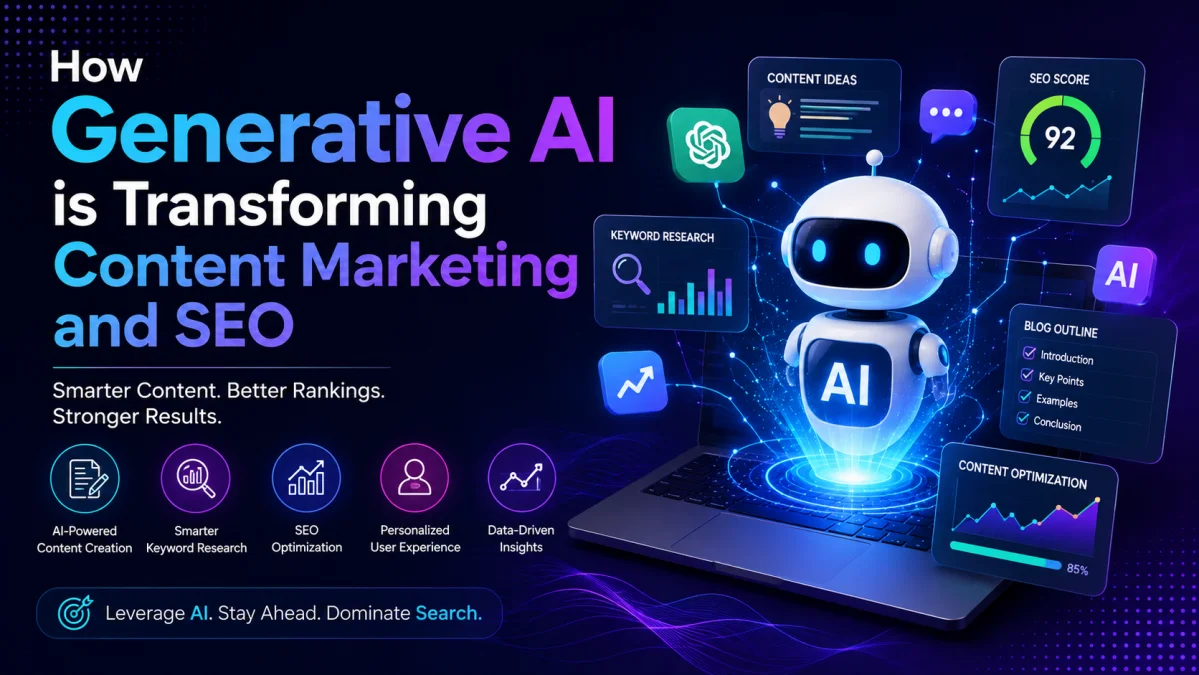
The most effective content marketing operations in 2026 are using an AI SEO content strategy to handle specific stages of the production process while maintaining rigorous human expertise oversight at the stages where AI reliably falls short.
Topic research and Outline of the first draft
Not every week will some innovation be waiting for the content writers to write about. When a professional struggles to decide what topic or subtopic to focus on, AI comes to the rescue with its immense capacity to skim through data quickly.
Also, for those who dread the empty white page/screen, generative AI for SEO can derive an outline that you can customize with or without FAQs easily.
Subject matter expert review and enhancement is the stage most organizations underinvest in and the one that most directly determines whether the content can break through the monotonality that pure AI output produces. SME input adds the specific examples, the genuine insight from direct experience, the counterintuitive perspective, and the original data that differentiates content from everything AI-generated alone.
On the accuracy side: include reputable references in prompts, ask AI to flag uncertainty rather than confabulate confidently, and ensure human editors review for factual accuracy before publication. On the originality side: inject unique examples and original viewpoints at every opportunity.
The Copyright Consideration Content Leaders Should Know
One practical consideration that marketing leaders often overlook: according to US Copyright Office guidance, content created wholly by AI cannot be copyrighted. Content created by humans and then adjusted or augmented by AI can be copyrighted.
For brands that treat their content library as an intellectual property asset, which any organization investing seriously in content marketing should, the human involvement in the creation process is not just a quality consideration. It is a rights consideration. Content that can't be owned can't function as a durable business asset in the way content investment is supposed to generate.
FAQs
Does AI help with every aspect of digital marketing?
To date, AI can automate SEO procedures, help you fin key wors, help you zero in on topics, and even come up with outlines. While it also helps with the content creation, most refrain from using entirely AI content for their website.
How do SEO professionals brace for the change?
Contrary to the belief that AI will absorb marketers' jobs, it has only modified and rather opened more doors for careers related to SEO and marketing.
If not keywords, what takes the stage for AI?
AI doesn't totally eliminate the use of keywords; in fact is uite neded, however, it requires content to be structured, with schema markup and clear enough.
What are the benefits of AI when it comes to content?
Faster research, fewer hours, and more capacity to produce valuable content, if done with skills, are a few of the benefits.
Does Fusion Logic help with AEO and GEO amid SEO?
Yes, Fusion Logic offers AI-friendly, yet genuine and visibly impressive digital marketing services.