
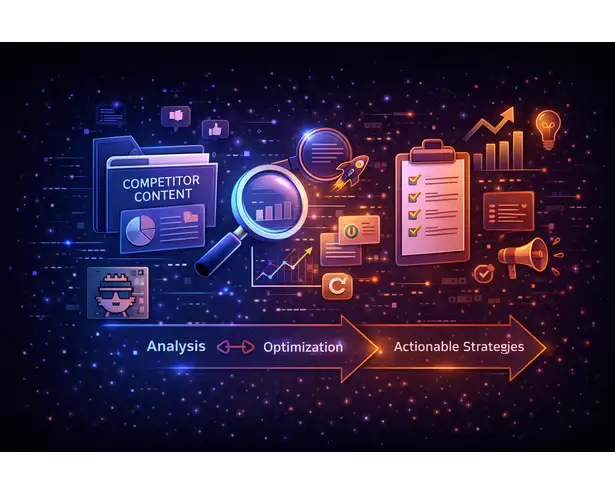
What business insights are missing that could provide your competitive advantage? Digital marketing has demonstrated that content is the primary force attracting audiences and establishing organizational authority for future business development. Impactful content production requires more than creativity since strategic thinking drives its creation. Professionals who study their competitors' content strategies can discover successful tactics that enable them to build superior strategies from this information.
The blog offers an in-depth guide for conducting competitive content analysis and provides instructions for transforming the results into strategic actions for achieving industry leadership.
What is Competitive Content Analysis?
To properly understand your competitor's content strategies, you should review their content, analyze its components, and draw conclusions from the data. A complete competitor content analysis involves reviewing their blogs, video content, SEO efforts, and social media activity.
Key Elements of Competitive Content Analysis:
- Content Types: Different formats (videos, infographics, and blogs) that the competition utilizes become essential for this analysis.
- Topics: Which topics generate the most engagement?
- Performance Metrics: What is the average audience engagement with their content, and which specific posts yield the best results?
- SEO Impact: Which specific search terms generate the highest traffic for their website?
Analyzing key aspects allows you to identify strategy weaknesses and discover opportunities for enhancement, establishing your digital advantage.
Why is Competitive Content Analysis Necessary?
The digital realm makes it challenging for marketers to produce content that stands out amidst the clutter. According to Backlinko statistics, Google detects more than 90% of all content posts, while only 0.63% of users click through to pages beyond the initial first search result page. Doing business without knowing what your competitors do will prevent your content from reaching your desired customer base.
Benefits of Competitive Content Analysis:
- Understanding Your Market: Understand your audience feedback by studying success stories from your competitors.
- Identifying Gaps: Organize your strategies around aspects where your competitors demonstrate weaknesses or demonstrate low performance.
- Improving ROI: Your focus must center around building content with measurable outcomes.
- Staying Relevant: The success of your content depends on your ability to match current trends with your audiences' expectations.
Your business can use data-based content tactics to achieve industry leadership. The Fusion Logic team is eager to discuss our free competitive analysis with you.
Step-by-Step Competitive Content Analysis
A methodical approach enables the development of functional strategies. The following section provides a detailed examination of each stage.
Step 1: Identify Your Competitors
Your analysis must begin by tracking both direct competitors and those that enter your market area indirectly. The same consumers buy from direct competitors because they offer similar products, yet indirect competitors appeal to these individuals using dissimilar products.
How to Identify Competitors:
- Google Search: Type your main search terms into Google to learn about dominant-ranking websites.
- SEO Tools: SEMrush, Ahrefs, and SpyFu tools will help you find your competitors by examining their organic traffic and paid advertisement information.
- Social Media Analysis: Strategic Analytics should observe influencers among your industry partners and brands operating within your market segment.
Competitor Type | Example
Direct Competitors | Nike vs. Adidas
Indirect Competitors | Apple vs. Microsoft (laptops)
Step 2: Gather Information on Your Competitors
After determining the competitive landscape, you can move forward with data compilation. Focus on:
- Content Formats: Do they generate content through blogs, videos, webinars, or infographics?
- Publishing Frequency: What is the scheduled frequency of their content creation?
- Engagement Metrics: Track down popularity indicators such as social media engagement and website page counts.
Tools for Data Collection:
- BuzzSumo: You need to analyze specific content that proves successful with backlinks and sharing data.
- SimilarWeb: Track website traffic and audience demographics.
- Google Alerts: Stay updated on any instances when your competitors are mentioned online.
Step 3: Decrypt Competitors' SEO Strategies
By assessing your competitors' SEO approaches, you can identify their selected keywords, preferred backlinks, and current ranking approaches.
Steps to Analyze SEO Strategies:
Keyword Analysis:
- Your search using SEMrush or Ahrefs will detect which keywords help your website rank best.
- To enhance your content, pinpoint the keywords where your competitors fall short.
Backlink Profile:
- Studies of backlinks enable you to discover noteworthy websites linking to their content.
- You should connect with these sites through upgraded content pitches.
Technical SEO:
- Monitor your competitors' site performance through page speed and mobile friendliness tests and validate their data labeling systems.
Example: Create a comprehensive guide comparing digital marketing tools to surpass competitor content and rank first for "Best Digital Marketing Tools 2024."
SEO Element | Competitor Example | Your Action Plan
High-Performing Keywords | "Social Media Strategy Tips" | Write a blog with unique case studies.
Backlinks | Links from industry blogs | Offer a guest post with better content.
Step 4: Perform a Competitor Content Analysis
Review the content type and quality standards maintained by your industry rivals. Look at:
- Content Depth: Do competitors provide detailed information about the content in their blogs?
- Tone and Style: What style does their content follow - formal, conversational, or storytelling-based?
- Content Gaps: Are there any topics they've overlooked?
Tip: When your competitor publishes a successful blog named "10 Email Marketing Tips," you should create "20 Advanced Email Marketing Strategies," including real-world case studies and expert insights.
Step 5: Assess Content Quality and Quantity
Competitors who publish much content can rank higher in search results, but focusing solely on frequency does not always guarantee top positions. Assess their:
- Posting Frequency: What is the frequency at which this company pushes out new content?
- Content Quality: The content provides practical insights alongside solid research support.
Example: Competitor's multiple insubstantial posts won't prevent your less frequent but more informative content from achieving higher search engine rankings.
Step 6: Research Their Content Distribution Channels
Content distribution techniques become vital when content lacks appropriate ways to reach its target audience successfully. Investigate the distribution channels along which your competitors spread their content material.
Key Distribution Channels:
- Social Media: For which social media channels do they reach the maximum audience engagement?
- Email Marketing: The website relies on newsletter distribution to attract website traffic.
- Paid Advertising: What advertising formats have their audience viewed (Google Ads, sponsored posts)?
Tip: When your competitor's new traffic comes from Instagram, you can target a previously skipped audience, but do not waste your efforts on Pinterest.
Turning Insights into Actionable Strategies
After your competitive analysis, you need to take action. Here's how:
- Develop Unique Content: Approach their plan improvement by answering existing questions while creating innovative perspectives.
- Focus on Underused Platforms: Direct marketing content to social networks that show lower engagement from your competitors.
- Optimize Keywords: You should aim for extended search phrases your competition has missed.
- Collaborate with Influencers: Collaborate with influential industry personalities to enhance reach potential.
Conclusion
The value of competitive content analysis goes beyond conventional research, providing a framework to develop practical strategic approaches. To achieve better rankings and enhance audience engagement, systematically analyzing your competitors' strengths and weaknesses is essential.
Pro Tip: Stay consistent with your analysis. Your strategies must adapt to the continuous changes that competitive business models have established.
Don't just compete—lead the way. Use Fusion Logic's consultation services to turn analytical insights into outstanding business success.
FAQs
Q1: What is competitive content analysis?
A: Studying competitor content lets you understand their methods while revealing their advantages and drawbacks so you can create better content.
Q2: What tools can help with content analysis?
A: SEMrush, Ahrefs, BuzzSumo, and SimilarWeb are popular tools for analyzing content performance and SEO strategies.
Q3: How do I identify gaps in competitor content?
A: The analysis highlights unanswered questions, outdated information, and areas not thoroughly explored in the content.
Q4: How often should I analyze my competitor's content?
A: Conduct competitive content analysis at least four times yearly or initiate major campaign launches.
Q5: Can I use competitor analysis for social media strategies?
A: Analyzing competitor engagement metrics and preferred social platforms forms a foundation for developing your social media strategy.
Executing these steps enables confident strategic refinement through competitive content evaluation, which leads to engaged audiences and business success. Your initial steps today will lead to visible differences.