Caution! This blog is for people who run any business and want to win the market. Or, you’re dreaming of taking your brand internationally. Regardless of your business goals, search engine optimization (SEO) is one of the only ways to increase your online visibility, drive traffic, and grow your business globally.
However, not all search engine marketing techniques are created equal. Local SEO and traditional SEO (additionally referred to as national SEO) are known for catering to unique business needs and focusing on your target audience only. Understanding the differences among these approaches is key to deciding on the proper strategy for your business.
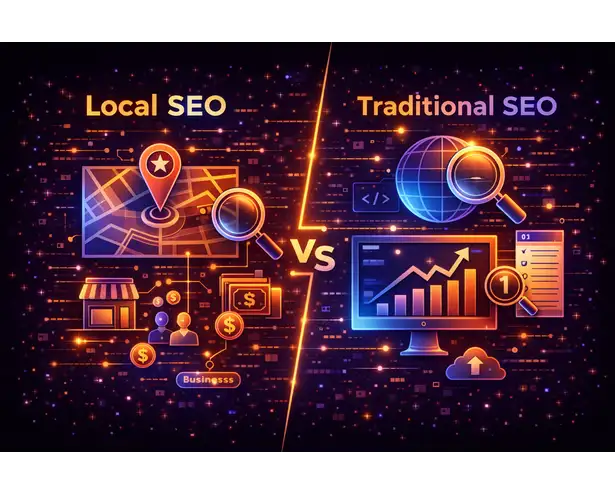
In this blog, we’ll compare local SEO to Traditional SEO, spotlight their key differences, and help you decide which technique best matches your goals. Let’s start with understanding Traditional SEO.
What is Traditional SEO?
Traditional SEO, or National SEO, specializes in optimizing a website to rank for broad, competitive keywords that concentrate on a large set of national or global audiences. The primary intention is to increase organic visitors by making your website appear on search engine results pages (SERPs) for applicable keywords.
How Does It Work?
The list below shows the points on which traditional or national SEO depends.
- Keyword Optimization: People search for “best digital marketing agency in San Diego” or “affordable digital marketing agency”; these keywords focus on specific businesses and audiences. So, try to focus on particular keywords to focus on quality traffic and more.
- Content Strategy: Always aim for excellent informational content that addresses various topics and aligns with your business's goals. Blogs, product descriptions, and guides regularly target general search terms that appeal to an international target market.
- Link Building: Building excellent backlinks from authoritative websites to establish trust and increase ratings. To build the link, you can rely on guest posts, influencer collaborations, and mentions on reliable websites. This all contributes to domain authority.
- Technical SEO is the most important part in terms of not losing your clients. Ensure the website speed is good, mobile friendliness is good, and the user experience is safe and secure.
Check If You’re One of Them.
- E-commerce websites targeting a country-wide or global client base.
- SaaS corporations aim to draw a wide range of users.
- Content-driven systems such as blogs, news websites, and digital magazines.
- National brands that want to set up authority throughout a couple of regions.
What is Local SEO?
Local Search Engine Optimization is best for organizations with multiple geographic locations and an aim to attract multiple customers. It enhances a business’s visibility in nearby search results, especially in Google’s Local Pack and Google Maps.
How Does Local SEO Work?
Take a look at the aspects that focus on local SEO:
- Google Business Profile (GBP) Optimization: Ensure that your GBP (previously Google My Business) is optimized with accurate business information, including name, address, mobile number (NAP), operating hours, and customer reviews.
- Local Keywords: Targeting region-precise key phrases that include geographical keywords such as “Digital marketing agency in Coronado, San Diego ” or “digital marketing services near me.”
- Local Citations: Ensuring your business's NAP data is consistent across online directories and local list systems like Yelp, Yellow Pages, and TripAdvisor.
- Customer Reviews: Encouraging happy clients to depart adequate opinions enables building trust and improving local scores.
- Localized Content: Creating content that caters to a local audience, such as blog posts about community events, local information, or region-specific services.
Check If You’re One of Them.
- Brick-and-mortar businesses, along with eating places, salons, and retail shops.
- Service carriers such as plumbers, electricians, and contractors.
- Medical and criminal experts who serve local areas.
- Local franchises seek to dominate their geographical marketplace.
What are the Differences Between Local SEO vs. Traditional SEO
Take a look at all the differences between local and traditional SEO:
Feature | Traditional SEO | Local SEO
Target Audience | National or global | Local or regional
Keyword Focus | Broad and competitive terms | Geo-targeted and location-specific terms
Search Intent | Informational or transactional | Immediate local needs or services
Competition | High due to broader audience | Lower due to a narrower local focus
Link Building | High-authority backlinks | Local business citations and partnerships
Google Maps/Local Pack | Not applicable | Essential for visibility
Conversion Potential | Lower for generic queries | Higher for local searches due to proximity
Why Local SEO Matters More Than Ever
Even though online shopping has become increasingly popular, many people prefer in-shop purchases and value local services. According to one survey, 92% of retail purchases still happen online. This suggests that local businesses can’t afford to ignore the strength of local search engine optimization.
Moreover, Google has stepped forward in its ability to detect local causes. Even if someone doesn’t include a local in their search question, Google’s algorithms can discover that the search is local and prioritize applicable local results. For instance, typing “eating place” in Google often triggers a list of nearby dining options, even without adding “near me” or a town name.
This makes it essential for local companies to maintain a sturdy Google Business Profile and ensure their information is accurate, current, and optimized for nearby searches.
Can One Business Use Both Strategies?
Yes, and lots of successful businesses do! A different search engine optimization technique allows corporations to target each local and national audience successfully. For example:
E-commerce brands can optimize their sites for national SEO and use local search engine marketing to force foot traffic to their physical shops.
Franchise corporations can benefit from local SEO for individual locations while maintaining a robust national search engine optimization strategy.
Combining each strategy allows groups to maximize their visibility across multiple channels, seize a broader audience, and increase their chances of converting local and national leads.
When to Choose Local SEO vs. Traditional SEO
Here is the list of reasons behind choosing local and traditional SEO for your business:
Choose Local search engine marketing if:
- Your business is based on foot visitors or serves a selected local area.
- You want to draw customers who are actively searching for nearby services.
- You must improve your visibility in Google’s Local Pack and Google Maps.
Choose Traditional SEO if:
- Your business provides services or products that can be accessed from anywhere.
- You’re trying to rank nationally or globally for distinctly aggressive keywords.
- You need to set up authority and trust for your business.
What’s the Best SEO Strategy to Boom Online Presence
Applying each local and traditional search engine optimization is brilliant if your business operates in a few markets or has an online and offline presence. Here’s how:
- Optimize Your Google Business Profile: Correct your NAP numbers and inspire shoppers' opinions.
- Create Location-Specific Landing Pages: Develop landing pages for every one of your locations to target nearby audiences.
- Develop High-Quality Blog Content: Produce content targeting preferred and location-specific key phrases.
- Build a Diverse Link Profile: Acquire one-way links from each authoritative country-wide website and relevant local directories.
Final Thoughts
Local SEO and traditional search engine optimization have their strengths, and the proper method relies on your business ideas, target market, and geographic reach. If you’re a local service company or a brick-and-mortar store, specializing in regional search engine marketing can power instant consequences and better conversion quotes. On the other hand, if your goal is to amplify your logo’s attainment nationally or internationally, conventional search engine marketing is your good guess.
A hybrid strategy that incorporates each tactic may produce excellent results for many businesses. By comprehending the subtleties of each approach and implementing them correctly, you may increase your exposure, attract more clients, and build your company sustainably.
Let’s get ready to enhance your online presence with the right SEO approach to run your business with local dominance, and can also help you achieve your goals!