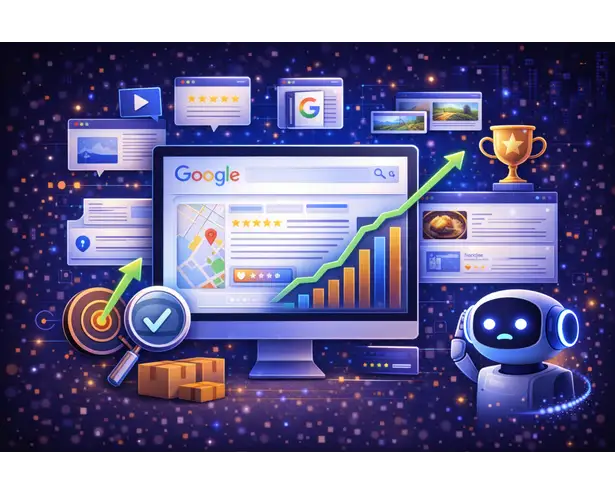
Remember your last Google search? Did you get what you wanted without having to click a link? Was it the local map result, a featured snippet, the People Also Ask box, or the AI Overview?
This is the new reality of search. Traditional blue links are now interspersed among various features. Still angling for that #1 spot? You must update your knowledge.
2026 will be different. You have to be present where people are really looking, not just in one spot.
Search in 2026: What You Have to Confront
98.51% of Google's first page now includes some kind of SERP feature. Most result pages you see have additional content vying for notice.
But there’s a twist: A large percentage of searches ended with zero clicks in 2024. Users find what they need right on Google without visiting any website. While that sounds scary, it's actually your opportunity. When your brand shows up in these zero-click results through snippets, knowledge panels, or AI Overviews, you're still winning mindshare.
There is a lot of variation in distribution strategies, depending on people’s requirements.
If you are looking for a restaurant, you will come across local suggestions and reviews. Asking a question takes you to featured snippets and AI overviews. Are you planning to shop? Expect image carousels and product grids everywhere.
Understanding which features appear for your keywords is no longer optional. It's your starting point for creating winning digital marketing strategies.
AI Overviews Are Dominating (And What to Do About It)
AI Overviews have exploded in the past year, systematically replacing product grids and other SERP features. By late 2025, they're showing up for roughly one in four searches.
What makes this tricky? Research shows that organic rankings and AI Overview citations are largely independent. Don’t expect that Google's AI will cite you for your top ranking. Different rules apply.
Here's what matters for AI visibility:
Create extractable content: Use clear headings. Breakdown complex content into bite-sized pieces. Your structure should be so clear that even AI can figure it out instantly. It’s a great way of explaining things to someone smart who doesn't yet know your field.
Answer questions directly: Lead with your answer, and put it right up top. Don't make people hunt for it. When someone's asking "What is X?", explain straight in your opening paragraph.
Build genuine authority: Reference solid sources. Regular updates help to keep your content modern. Demonstrate that you are keeping current with events in your environment rather than publishing and moving on.
Good schema markup lets Google know what your page genuinely is about. It's basically giving them a map to better understand your content.
Featured Snippets Still Count
Despite AI Overviews growing in popularity, featured snippets remain relevant. Back in January 2025, they showed up for 18% of searches. That's huge visibility.
The secret? Featured snippets love precision. Ever notice that boxed answer at the top when you search? It's typically 40-60 words of really well-written explanation.
How to Actually Win Featured Snippets
First, find your opportunities. Grab tools like Semrush or Ahrefs and look for queries where snippets exist and you're already on page one. That's the easy stuff to grab.
Structure matters enormously. Add "What is X" directly above your definition when appropriate. This signals to Google that you're providing a direct answer.
Match the format you see. If Google's showing a list snippet, use proper HTML list formatting. Table snippet? Create an actual HTML table, not a graphic. The same table from your content can appear directly in the results.
Definitions must be brief but informative. A 40-60-word snippet will allow Google to use it directly. Don't beat around. Simply answer the question clearly and move on.
Implement the FAQ schema for question-based content. This significantly increases your chances of appearing in both snippets and People Also Ask boxes.
Local Pack: Your Physical Location's Best Friend
For any business with a physical presence, the local pack is prime real estate.
Your Google Business Profile matters the most. Pick the most specific category for what you actually do. If you've got a specialty, use it. Example: Using ‘Personal Injury Attorney’ will get you more leads than using ‘Law Firm’ every single time.
Fill out every section and every field. Upload photos regularly. Create posts about local events. Show Google you're actively engaged with your community.
Reviews matter big time in local search. Try getting 12-15 solid five-star reviews. Then keep adding fresh ones every month. Fresh reviews signal active business.
Create distinct local keyword-laced pages on your site for every site. Triple-check that your name, address, and phone number are the same across every directory entry and in any place where they may be viewed. Small differences throw search engines off.
Add Local Business schema markup. Embed a Google Map. Write blog content about neighborhood topics. These signals tell Google you're genuinely rooted in your local area. You can achieve this with the best digital marketing services.
The Underrated Power of People Also Ask
PAA boxes offer unique value. You can appear here and hold a regular ranking on the same page. Related searches show up in 92% of the top 20 Google results, with People Also Ask appearing in 50.7%.
Better yet? 74% of sites appearing in PAA boxes aren't on the first page of organic results. This means newer sites without massive authority can capture visibility through smart optimization.
Find PAA questions using tools like AlsoAsked or AnswerThePublic. Look for questions your content doesn't currently address.
Use question-based subheadings (H2 or H3) that match the exact phrasing of PAA queries. Provide clear answers in 2-3 sentences immediately below. The answer should make sense.
Create comprehensive FAQ pages with multiple Q&As. Implement FAQ schema markup. Remember that PAA boxes expand dynamically. One question leads to more, creating opportunities to capture multiple related queries.
Video Content? You Can't Skip It
You'll see video snippets and carousels pop up all the time for queries, especially how-tos and product demos. Ignoring video means leaving visibility on the table.
YouTube remains king for video search. Optimize titles with target keywords.
For longer videos, include thorough descriptions and timestamps. Work with professional SEO services. Though they remain somewhat crucial for informative searches, Google curtailed shopping results videos beginning in August 2024.
Create content that addresses problems. That includes tutorial-style videos and product comparisons. Keep mobile in mind. Ensure videos work on small screens without sound. Use captions.
And don't sleep on short-form content. TikTok SEO jumped 119% year-over-year, and younger people are hitting up TikTok and Instagram before they even think about Google for quick tips and recommendations.
Structure Content for Multiple Features Simultaneously
Want to maximize presence across several SERP features at once? Strategic structuring is everything.
Start with a comprehensive coverage of your main topic, along with related questions. Use a clear hierarchy with descriptive headings. Include a table of contents for longer content.
Combine different formats on individual pages: brief paragraphs for snippets, bulleted lists for list results, data tables for comparison queries, embedded videos for people who learn visually, and FAQ sections for PAA chances.
Stack your schema markup. When they fit, the article schema, the how-to schema for lessons, and the product schema have to be added. Videos should use the VideoObject schema; queries and answers should use the FAQ schema.
Identify the technical features. Page speed impacts rankings. Make sure you've got fast loading, mobile works perfectly, and solid user experience signals.
Tracking What Actually Works
You can’t improve if you are not measuring. Today's rank tracking has to go beyond just tracking positions. You need eyes on SERP features too.
Position Tracking in Semrush, Ahrefs Rank Tracker, or similar tools that actually track features are highly recommended. Have an eye on featured snippets, PAA boxes, local pack spots, video carousels, and things that matter for your keywords.
Create separate dashboards for different feature types. Track which keywords trigger which features, appearance frequency versus competitors, changes over time, and estimated traffic impact.
Pay attention to volatility. SERP features change frequently. Regular monitoring helps you respond when competitors capture your positions or new opportunities emerge.
Building Long-Term Visibility That Lasts
One-time optimization doesn't cut it. Success in 2026 requires continuous execution.
Aim for multi-feature presence on your highest-value topics. Don't settle for appearing in just one feature. Target 3-4 different touchpoints for comprehensive visibility.
Focus on topical authority rather than isolated keywords. Create content clusters covering subjects thoroughly. Link related pieces together to signal topical relationships.
It’s important to stay agile. Run monthly ‘trend sprints’ in which your team collaborates on 1-2 emerging topics. Identify rising search terms with growing momentum. Early authoritative content on emerging topics can secure long-term dominance.
Keep existing featured positions fresh. Update statistics. Add new information. Refresh examples. Google favors current, well-maintained content for many features.
Build authority beyond your site. Earn backlinks from industry sources. Contribute to publications. Participate authentically in relevant communities. These external signals increasingly influence which sources Google selects for AI Overviews and features.
The Path Forward
Companies doing well in 2026's search world get one thing: it's not about ranking in one spot anymore. It's about making your brand the go-to authority people see across different places.
Every SERP feature you land gives you another chance to reach potential customers. Featured snippets, AI Overviews, local packs, and PAA boxes are all pieces of a comprehensive visibility puzzle.
Start by auditing your current presence. Where do you already appear? Where are the gaps? Then systematically optimize for multiple feature types relevant to your industry. Measure performance consistently. Iterate based on results.
The framework is straightforward: be present, be authoritative, and be everywhere your customers search. That's the way to succeed in 2026 and beyond.