Your PPC dashboard shows you have stayed within the budget. Everything seems to be alright. Then you sit down to calculate actual ROI, and something feels wrong. The returns just don't match what you put in, and you are trying hard to figure out where the money actually went.
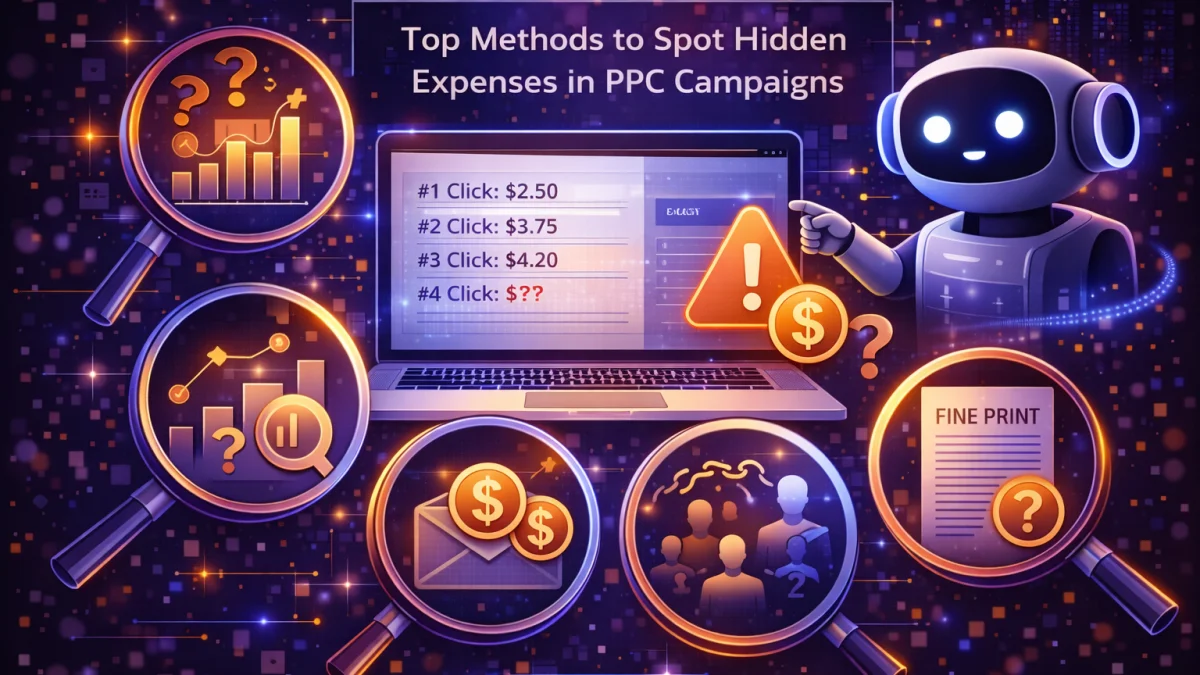
This happens often with businesses running paid campaigns. Your daily ad spend and the clicks you bought are only part of what PPC really costs you. There's a whole bunch of hidden expenses sitting underneath, taking up your budget, while your standard reports make everything look fine.
Why You Need to Care About This Right Now
Cost per click hit incredible highs across most industries in 2026. Legal and finance keywords are now over $50 per click. Even the less competitive ones keep climbing every quarter.
Most businesses use nearly a quarter of their marketing budget on PPC, expecting real results. Studies tracking actual performance show that poorly managed campaigns waste 15-30% of total spend on activities that never appear anywhere.
The difference between making money on PPC and burning cash? Catching these hidden drains before they take away a large chunk of your budget.
Quality Score Quietly Doubling What You Pay
Quality Score works like a tax or discount on every single click based on how Google rates your ads. It considers your ad relevance, predicted click-through rate, and landing page experience to assign a score of 1–10. Most users check it once when setting it up, then totally forget about it. That’s a big mistake.
Here's the thing. Someone with a Quality Score of 8 pays maybe $3 per click for a keyword. Another person targeting that same keyword with a Quality Score of 4? They're paying $6 for the identical click. Same keyword, same spot on the page, double the cost. That multiplier just runs in the background, wasting your money.
Your digital marketing strategies need to treat Quality Score like ongoing maintenance, not something you set up once and walk away from. Check these scores regularly across your keywords, and you'll find where you're overpaying. Low scores mean you found a leak worth plugging immediately.
Fix it by making your ad copy match search intent precisely. Get your landing pages loading under three seconds. Make sure the mobile works well. Test different ad versions until your click-through rates beat platform averages. Do this, and you are directly cutting your per-click cost without touching anything else.
Negative Keywords You're Missing Cost You Thousands
Negative keywords are the searches you don't want to show your ads for. Without good negative keyword lists, your campaigns show up for all kinds of irrelevant stuff that sounds related but attracts the wrong audience.
If you are selling premium software, your ads might trigger for searches with "free," "cheap," "download," or "cracked version" in them. People searching for those things will never pay you, but you're still paying for every click they make. Those clicks add up fast.
Broad match makes this worse. Google keeps pushing broad game, saying its algorithms understand intent well enough. The reality is that broad match triggers ads on searches that technically match your keywords but show a completely different intent from what you actually serve.
Adding comprehensive negative keywords can cut wasted spend by 30% without losing any qualified traffic. That's money you're already spending that could actually convert instead of just disappearing.
You must review search query reports every week.
- Find patterns in irrelevant searches that trigger your ads.
- Add the obvious ones like "free," "cheap," "jobs," "DIY," depending on what you sell.
- Look for competitor brands you don't want mixed up with your ads.
- Flag informational searches when you're trying to catch buyers.
Any experienced digital marketing company knows this work never stops. New irrelevant searches pop up constantly. Language changes, search patterns shift. You either keep managing negative keywords or you keep wasting money.
The Fees and Tools Nobody Includes in Reports
Your ad spend shows up in every report. But what about all the other things you need just to run campaigns?
Agency fees range from $1,500 to $10,000 per month for fixed retainers. Or 10-30% of ad spend if they charge percentages. That's big money on top of what platforms get directly.
Then you've got tool subscriptions. Professional PPC needs specialized software. SEMrush, Ahrefs, Optmyzr, and automation tools each charge a monthly fee. Total those up, and you're easily at $500-2,000 per month for good toolsets.
Creative production costs money that never appears in PPC reports. Quality ad copy, good visuals, video content, and landing page design all require investment. These expenses count, regardless of whether you use freelancers or pay creative fees to agencies.
Calculate the true cost per acquisition by including everything. That click might cost $5, but add management, tools, and creative, and it actually costs $7.50. Skip these expenses in your math, and you'll think campaigns are profitable when they're really not.
Working with an experienced internet marketing company means getting transparent pricing that shows all costs, not just platform spend.
Conversion Tracking That Paints a Wrong Picture
Conversion tracking problems create blind spots where you think something performs great when it's actually wasting money, or you think something's failing when it's really your best performer.
The Common Problems?
- Missing conversion pixels on important pages.
- Wrong attribution windows.
- Not tracking micro-conversions that lead to big conversions.
- Counting the same conversion multiple times and inflating your numbers.
Each one messes up your understanding of what's working.
Good conversion tracking goes way beyond slapping a pixel on your thank-you page. Track assisted conversions showing the full journey across touchpoints. Multi-touch attribution shows which campaigns deliver real results and which get credit. Phone call tracking catches offline conversions. Form tracking needs to separate spam from real leads.
Expert digital marketing services start tracking right from the beginning. Correct your tracking, and you'll be able to identify the exact keywords, ads, groups, and locations that deliver real value. Quit funding items that seem effective in surface statistics but really serve no use to your company.
This alone can recover 20-30% of wasted spend just by moving the budget toward what works.
Bots and Fraud Stealing Your Clicks
Not every click comes from someone who might buy. Some come from:
- Competitors are trying to inflate your costs.
- Bots running automated scripts.
- People fat-fingering their phones and accidentally clicking.
- Click farms are generating fake engagement.
Industry estimates say 10-20% of paid clicks might be fraudulent or invalid, depending on your industry and who you target. For every $10,000 you spend on clicks, $1,000-2,000 potentially goes to non-human traffic or people deliberately misleading you.
Google filters out obvious invalid clicks and gives credit, but it's not perfect. Sophisticated fraud operations mimic human behavior well enough to pass automated checks. Unless you actively watch for suspicious patterns, this hidden cost becomes your normal spending.
Watch for sudden click spikes with no increase in conversions. The common signs?
- Traffic from weird locations that don't match your targeting.
- High bounce rates on specific campaigns.
- Clicks are bunching up during odd hours.
- The same IP addresses are clicking repeatedly.
Fix this by blocking IP addresses showing sketchy patterns. Use fraud detection tools that alert you when weird activity happens. Check geographic reports for traffic from places you don't even target. Review time-of-day stats to catch clicks happening when your real audience wouldn't be searching.
Partner with a skilled lead generation company in the USA, and you benefit from their ability to spot fraud patterns across thousands of client accounts. They spot issues way faster than someone just managing one account because they've seen these schemes over and over.
Finding the Gaps Through Auditing
Discovering hidden costs requires methodical auditing. Meticulous auditing will show what's leaking your budget. Usually, impressions, clicks, conversions, and other top-level metrics are checked weekly or monthly. Although it's vital, it probably won't reveal cost leakage.
Conduct thorough audits every three months. Identify the low-rated keywords that cost more by checking Quality Scores for every currently active keyword. Review search query data and include unfavorable keywords to eliminate pointless traffic. Check the accuracy of the tracking by comparing platform reports with the company's actual results.
Look at traffic patterns for signs of fraud, such as weird geographic clusters or strange timing.
These audit reports are surprising. The keyword you thought worked might have a low Quality Score, potentially driving costs higher. A campaign generating conversions might include 30% invalid bot clicks. Ad groups might trigger on hundreds of irrelevant searches you never meant to target.
Businesses serious about PPC efficiency treat audits as required maintenance, not optional exercises. Time invested in audits pays for itself many times over by cutting waste.
To ensure these audits are conducted consistently, collaborate with professional SEO and PPC experts. They know what to search for, where leakages are happening, and how to address problems quickly without compromising performance.
The Math That Reveals Facts
Do the math most businesses skip.
The total PPC investment includes ad spend, management fees or staff costs, tool subscriptions, creative production, and landing page. Divide by actual qualified conversions, real opportunities, not clicks or junky leads. That's your true cost per acquisition.
This math often shows campaigns you thought were profitable actually lose money once you count all costs properly. Sometimes it shows the opposite, too. Campaigns looking barely profitable are actually killer once you attribute their full contribution correctly.
Either way, real numbers change everything. You might realize you should aggressively scale certain campaigns because the actual economics support it. You might find you need to pause campaigns immediately because they're destroying value. Can't make these decisions without an honest accounting of what everything really costs.
Conclusion
Hidden PPC costs destroy budgets quietly while your reports show everything's fine. Quality Score issues inflate costs invisibly. Missing negative keywords waste money on wrong searches. Fees and tools add to the invisible costs. Bad tracking hides what's real. Click fraud steals from your marketing budget. Stack these together, and you're wasting 15-30% of your spend without even knowing.
Don’t let hidden costs kill your PPC performance.
Fusion Logic runs comprehensive audits to pinpoint exactly where your budget leaks and systematically fix those leaks.