Every website owner and team of digital marketers have implemented traditional SEO strategies for years, but the methods have changed. Still, the goal remains: to rank higher on Google with the best SEO strategies.
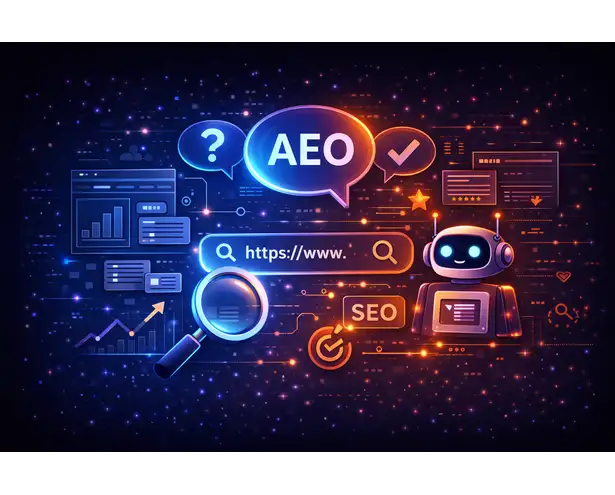
As a priority, we must also focus on the challenges that have popped up in recent years: Answer Engine Optimization (AEO). This strategy is entirely focused on optimizing your Content to appear as a direct answer to all your queries through AI generators like ChatGPT, Alexa, Bard, and more.
Let us explain everything so you can conclude that AEO is the next big thing and how you can implement it.
What is AEO?
AEO stands for Answer Engine Optimization. Before understanding AEO, let's talk about Answer Engines. SEO is for search engines, while this AEO is for direct AI-driven answer engine platforms. All AI-driven systems like Amazon Alexa, Siri, and ChatGPT fall under AEO as they deliver direct answers to users without visiting any website.
The algorithm works as follows: anytime you search for a query, the engine returns the most relevant results and presents them at the top.
For example, if you ask Alexa, "What is the capital of the US?" she will respond, "The capital of the US is Washington, D.C." This answer is delivered instantly and requires no more effort to dig down in weblinks.
So, AEO is the process of optimizing Content to become the preferred answer for these engines. Instead of just ranking on Google's search results, your Content will be positioned as the direct response to user queries.
How is AEO different from SEO?
Both AEO and SEO share similarities, but they have distinct goals regarding platforms. SEO involves content optimization to rank higher in search results, while in AEO, our focus is on optimizing Content to become the direct answer to user queries.
Instead of targeting keyword rankings, AEO ensures that Content is structured so search engines can easily interpret and use it.
Why is AEO Important?
We are all surrounded by at least 4-5 people who use voice search commands for quick and direct answers rather than a list of web links. Yes, we all know voice search is rapidly growing with intelligent assistants like Siri, Alexa, and more; AEO plays a critical role in this era.
Zero-click searches are also becoming more common. This indicates that a substantial portion of Google searches never end in a click on a website, as visitors can locate what they're looking for in the knowledge panel or highlighted snippet. Your Content may rank as the most popular response if it is AEO optimized, which would raise the visibility and trustworthiness of your business.
With time, every product, platform, and technology prioritizes user experience. The same AEO does this by helping users get the best and fastest answer. Users are more likely to trust your brand when your Content is well-structured and offers factual information, which might result in conversions.
What are the key strategies for implementing AEO effectively?
If you want your Content to be ranked on Answer engines, it is essential to implement AEO strategies. Here's how you can do it:
1. Optimize Content for featured snippets
The best example of AEO in action may be in Google's Featured snippets. These are the quick answers that show up first in the search results. To optimize for snippets:
- Use clear and concise answers.
- Structure content with questions and answers.
- Use bullet points or numbered lists where relevant.
2. Focus on Conversational Queries
Each voice assistant relies on natural language processing, so your Content needs to be conversational, and you need to answer each of your queries directly.
- First, use long-tail keywords. For example, avoid using SEO tips when asking, "What are the best SEO tips for beginners?"
- Write the Content in a Q&A format, which needs to be similar to people asking questions in real life.
3. Use Schema Markup to Improve Content Structure
Schema markup is a form of structured data that helps search engines understand your Content better. Few of the schemas are FAQ schemas. Learn how to use schema and Q&A schema. Focus on implementing all of them to make your Content attractive to search engines.
4. Build a Knowledge Graph for Your Brand
A knowledge graph is a collection of linked information about your business. Google and AI-driven systems rely on knowledge graphs to provide better answers. Ensure your brand has a strong online presence with consistent information on:
- Wikipedia
- Google My Business
- Social media profiles
- Industry directories
5. Local Searches Optimization
People directly ask the voice assistant, "Where is the nearest coffee shop?" So, this type of answer requires local search optimization. If you have a local business and want to attract local customers, ensure your GMB or Google Business Profile is updated with accurate details, including address, phone number, and working hours.
6. Ensure Fast Page Load Speed and Mobile-Friendliness
Even though answer engines often pull direct answers, search engines prioritize fast and mobile-friendly websites. Improve your website's loading speed, mobile usability, and overall user experience to boost your chances of being selected as the top answer.
Know the Future of AEO in SEO
Answer Engine Optimization (AEO) is more than simply a quick sensation; it is the next stage of SEO. Search and answer engines are becoming more intelligent as a result of the development of AI and machine learning. They consider context, purpose, and relevancy in addition to keywords. Businesses using AEO will be competitive in building higher brand authority, visibility, and engagement.
If you're new to SEO, start using structured Content, conversational language, and schema markup. These modest efforts can significantly improve your web exposure. And, once you adapt there will be higher chances of remaining competitive in this AI-driven world.